FordeFables
Follow Me:
  • Home
  • Site Index
  • About Me
    • Radio Interviews
  • My Books
    • Book List & Themes
    • Strictly for Adults Novels >
      • Rebecca's Revenge
      • Come Back Peter
    • Tales from Portlaw >
      • No Need to Look for Love
      • 'The Love Quartet' >
        • The Tannery Wager
        • 'Fini and Archie'
        • 'The Love Bridge'
        • 'Forgotten Love'
      • The Priest's Calling Card >
        • Chapter One - The Irish Custom
        • Chapter Two - Patrick Duffy's Family Background
        • Chapter Three - Patrick Duffy Junior's Vocation to Priesthood
        • Chapter Four - The first years of the priesthood
        • Chapter Five - Father Patrick Duffy in Seattle
        • Chapter Six - Father Patrick Duffy, Portlaw Priest
        • Chapter Seven - Patrick Duffy Priest Power
        • Chapter Eight - Patrick Duffy Groundless Gossip
        • Chapter Nine - Monsignor Duffy of Portlaw
        • Chapter Ten - The Portlaw Inheritance of Patrick Duffy
      • Bigger and Better >
        • Chapter One - The Portlaw Runt
        • Chapter Two - Tony Arrives in California
        • Chapter Three - Tony's Life in San Francisco
        • Chapter Four - Tony and Mary
        • Chapter Five - The Portlaw Secret
      • The Oldest Woman in the World >
        • Chapter One - The Early Life of Sean Thornton
        • Chapter Two - Reporter to Investigator
        • Chapter Three - Search for the Oldest Person Alive
        • Chapter Four - Sean Thornton marries Sheila
        • Chapter Five - Discoveries of Widow Friggs' Past
        • Chapter Six - Facts and Truth are Not Always the Same
      • Sean and Sarah >
        • Chapter 1 - 'Return of the Prodigal Son'
        • Chapter 2 - 'The early years of sweet innocence in Portlaw'
        • Chapter 3 - 'The Separation'
        • Chapter 4 - 'Separation and Betrayal'
        • Chapter 5 - 'Portlaw to Manchester'
        • Chapter 6 - 'Salford Choices'
        • Chapter 7 - 'Life inside Prison'
        • Chapter 8 - 'The Aylesbury Pilgrimage'
        • Chapter 9 - Sean's interest in stone masonary'
        • Chapter 10 - 'Sean's and Tony's Partnership'
        • Chapter 11 - 'Return of the Prodigal Son'
      • The Alternative Christmas Party >
        • Chapter One
        • Chapter Two
        • Chapter Three
        • Chapter Four
        • Chapter Five
        • Chapter Six
        • Chapter Seven
        • Chapter Eight
      • The Life of Liam Lafferty >
        • Chapter One: ' Liam Lafferty is born'
        • Chapter Two : 'The Baptism of Liam Lafferty'
        • Chapter Three: 'The early years of Liam Lafferty'
        • Chapter Four : Early Manhood
        • Chapter Five : Ned's Secret Past
        • Chapter Six : Courtship and Marriage
        • Chapter Seven : Liam and Trish marry
        • Chapter Eight : Farley meets Ned
        • Chapter Nine : 'Ned comes clean to Farley'
        • Chapter Ten : Tragedy hits the family
        • Chapter Eleven : The future is brighter
      • The life and times of Joe Walsh >
        • Chapter One : 'The marriage of Margaret Mawd and Thomas Walsh’
        • Chapter Two 'The birth of Joe Walsh'
        • Chapter Three 'Marriage breakup and betrayal'
        • Chapter Four: ' The Walsh family breakup'
        • Chapter Five : ' Liverpool Lodgings'
        • Chapter Six: ' Settled times are established and tested'
        • Chapter Seven : 'Haworth is heaven is a place on earth'
        • Chapter Eight: 'Coming out'
        • Chapter Nine: Portlaw revenge
        • Chapter Ten: ' The murder trial of Paddy Groggy'
        • Chapter Eleven: 'New beginnings'
      • The Woman Who Hated Christmas >
        • Chapter One: 'The Christmas Enigma'
        • Chapter Two: ' The Breakup of Beth's Family''
        • Chapter Three: From Teenager to Adulthood.'
        • Chapter Four: 'The Mills of West Yorkshire.'
        • Chapter Five: 'Harrison Garner Showdown.'
        • Chapter Six : 'The Christmas Dance'
        • Chapter Seven : 'The ballot for Shop Steward.'
        • Chapter Eight: ' Leaving the Mill'
        • Chapter Ten: ' Beth buries her Ghosts'
        • Chapter Eleven: Beth and Dermot start off married life in Galway.
        • Chapter Twelve: The Twin Tragedy of Christmas, 1992.'
        • Chapter Thirteen: 'The Christmas star returns'
        • Chapter Fourteen: ' Beth's future in Portlaw'
      • The Last Dance >
        • Chapter One - ‘Nancy Swales becomes the Widow Swales’
        • Chapter Two ‘The secret night life of Widow Swales’
        • Chapter Three ‘Meeting Richard again’
        • Chapter Four ‘Clancy’s Ballroom: March 1961’
        • Chapter Five ‘The All Ireland Dancing Rounds’
        • Chapter Six ‘James Mountford’
        • Chapter Seven ‘The All Ireland Ballroom Latin American Dance Final.’
        • Chapter Eight ‘The Final Arrives’
        • Chapter Nine: 'Beth in Manchester.'
      • 'Two Sisters' >
        • Chapter One
        • Chapter Two
        • Chapter Three
        • Chapter Four
        • Chapter Five
        • Chapter Six
        • Chapter Seven
        • Chapter Eight
        • Chapter Nine
        • Chapter Ten
        • Chapter Eleven
        • Chapter Twelve
        • Chapter Thirteen
        • Chapter Fourteen
        • Chapter Fifteen
        • Chapter Sixteen
        • Chapter Seventeen
      • Fourteen Days >
        • Chapter One
        • Chapter Two
        • Chapter Three
        • Chapter Four
        • Chapter Five
        • Chapter Six
        • Chapter Seven
        • Chapter Eight
        • Chapter Nine
        • Chapter Ten
        • Chapter Eleven
        • Chapter Twelve
        • Chapter Thirteen
        • Chapter Fourteen
      • ‘The Postman Always Knocks Twice’ >
        • Author's Foreword
        • Contents
        • Chapter One
        • Chapter Two
        • Chapter Three
        • Chapter Four
        • Chapter Five
        • Chapter Six
        • Chapter Seven
        • Chapter Eight
        • Chapter Nine
        • Chapter Ten
        • Chapter Eleven
        • Chapter Twelve
        • Chapter Thirteen
        • Chapter Fourteen
        • Chapter Fifteen
        • Chapter Sixteen
        • Chapter Seventeen
        • Chapter Eighteen
        • Chapter Nineteen
        • Chapter Twenty
        • Chapter Twenty-One
        • Chapter Twenty-Two
  • Celebrity Contacts
    • Contacts with Celebrities >
      • Journey to the Stars
      • Number 46
      • Shining Stars
      • Sweet Serendipity
      • There's Nowt Stranger Than Folk
      • Caught Short
      • A Day with Hannah Hauxwell
    • More Contacts with Celebrities >
      • Judgement Day
      • The One That Got Away
      • Two Women of Substance
      • The Outcasts
      • Cars for Stars
      • Going That Extra Mile
      • Lady in Red
      • Television Presenters
  • Thoughts and Musings
    • Bereavement >
      • Time to clear the Fallen Leaves
      • Eulogy for Uncle Johnnie
    • Nature >
      • Why do birds sing
    • Bill's Personal Development >
      • What I'd like to be remembered for
      • Second Chances
      • Roots
      • Holidays of Old
      • Memorable Moments of Mine
      • Cleckheaton Consecration
      • Canadian Loves
      • Mum's Wisdom
      • 'Early life at my Grandparents'
      • Family Holidays
      • 'Mother /Child Bond'
      • Childhood Pain
      • The Death of Lady
      • 'Soldiering On'
      • 'Romantic Holidays'
      • 'On the roof'
      • Always wear clean shoes
      • 'Family Tree'
      • The importance of poise
      • 'Growing up with grandparents'
    • Love & Romance >
      • Dancing Partner
      • The Greatest
      • Arthur & Guinevere
      • Hands That Touch
    • Christian Thoughts, Acts and Words >
      • Reuben's Naming Ceremony
      • Love makes the World go round
      • Walks along the Mirfield canal
  • My Wedding
  • My Funeral
  • Audio Downloads
    • Audio Stories >
      • Douglas the Dragon
      • Sleezy the Fox
      • Maw
      • Midnight Fighter
      • Action Annie
      • Songs & Music >
        • Douglas the Dragon Play >
          • Our World
          • You On My Mind
        • The Ballad of Sleezy the Fox
        • Be My Life
    • 'Relaxation Rationale' >
      • Relax with Bill
    • The Role of a Step-Father
  • My Singing Videos
    • Christmas Songs & Carols
  • Bill's Blog
    • Song For Today
    • Thought For Today
    • Poems
    • Funny and Frivolous
    • Miscellaneous Muses
  • Contact Me

October 31st, 2016.

31/10/2016

0 Comments

 
Thought for today:
​"My first ever holiday to Italy was when Sheila and I went to beautiful Sorrento in 2011; a coastal town in southwestern Italy which faces the Bay of Naples on the Sorrentine Peninsular. We found Sorrento thoroughly enchanting, but given that we were in the first flush of love, we would have found things to do and even enjoyed ourselves in a Barnsley hotel overlooking a fish market, had we not gone abroad!

Just as one can taste the difference in Irish and English Guinness, the same distinction is true of Italian Pizzas, tomatoes, lemons and many other delicious foods which no other place can compete with. I loved taking a boat ride around the Isle of Capri where we saw the cliff-top residence of the late Gracy Fields. My most memorable experience of the boat trip was entering the mouth of the Blue Grotto; a dark cavern where the sea glows electric blue through the sunlight of an underwater cave. Across the sea from Sorrento lies Mount Vesuvius, the infamous volcano that looms over the Bay of Naples. Vesuvius, which erupted in 1944, is the only volcano on mainland Europe to have erupted during the past hundred years.

While there are too many beautiful churches and other famous buildings for Sorrento to boast of, in 1873, Sorrento gave birth to the operatic tenor Enrico Caruso. The two things which intrigued me most about Sorrento's historic centre was an area known as the Drains and the nightly convention for men, women, boys, girls and entire families to walk up and down the main street, even way past midnight, for no other purpose than to strut their stuff. The Drains is a warren of narrow alleys and a maze of shops, blended with numerous eatings places. Once in this warren, unless one is a rodent, it is easy to lose one's bearings. It was from one of the mazed alley exits that we alighted upon the Chiesa di San Francesco; a beautiful 14th-century church with the most tranquil cloister I have ever seen. We finished our Italian holiday off with a night at The Royal Opera House; one of the world's greatest opera companies which weekly shows the amazing performances and superb skills of world-class dancers.

What has Italy got to do with my morning post you might ask. We had planned to take another Italian holiday over the coming year and during the months ahead we would have had much pleasure looking through the various Italian places we have yet to see. Given my increasing loss of mobility and the risk I take on air flights with my condition, however, we have decided to holiday within the British Isles. Given my condition, we can never be away from home on holiday for more than a week.

So, now knowing that the first time I ever saw beautiful Italy would be my last, I needed to exercise my own piece of literary indulgence and pen a brief travel guide of Sorrento and the Bay of Naples for my own future recall. 

There are many places in the British Isles that I would like to see again with Cornwall, the Scottish Highlands, North Wales and South West Ireland being chief among them; so these are the places we will next be having a week's holiday away in the New Year.

With my mobility becoming more restricted daily due, to severe Osteoarthritis and Rheumatoid Arthritis in my hips and legs for most of my adult life, along with a terminal leukemia condition which leaves my blood short of oxygen and body devoid of sufficient energy, any sight seeing for me in the future will have to be done from the seat of a wheelchair, pushed by my beloved Sheila. I recently broke the psychological barrier that I'd been resisting for a year now and bought myself a wheelchair, light enough to carry and store and strong enough to hold my excess weight. I'm just so pleased that Sheila keeps so fit and in great shape.


​They do say, 'See Naples and die,' don't they? Not yet mate! I've still got places to go, people to meet, books to write and things to do! And below is a lovely man who I had a cup of coffee with and a long chat during early morning hours during 1964 which can be read about from my website." William Forde: October 31st, 2016.
http://www.fordefables.co.uk/sweet-serendipity.html

https://youtu.be/69O4PXzAQ5Y

Picture
0 Comments

October 30th, 2016.

30/10/2016

0 Comments

 
 Thought for today:
"I don't know why some people knock support groups of one type or another, as in my experience, they are a real means of helping a person come to terms with their situation or the condition they suffer from. It matters not what set of circumstances or type of person the group supports: the simple fact is that they do what it says on the tin; they support!

Throughout my professional career as a Probation Officer, Group Worker, Relaxation Trainer, Stress Management Consultant and Bereavement and Marriage Counsellor, I have seen the value offered by support groups, whether members be an addict of drink, gambling, drugs or sex; a victim or the perpetrator of burglary, bullying, rape or physical assault: or a divorcee or access parent, the family of a person run down by a drunk motorist or killed in some other manner. While the circumstances of their trauma and painful situation may never be fully resolved, often the first step to recovery involves acknowledging the situation and being brave and bold enough to talk about it. The greatest agony can often be the bearing of an untold hurtful story inside a person, wanting to be aired, but fearful of the consequences of how it will be received and responded to.


There is an immediate feeling of inner security to be found in learning that we are not alone in our adversity. I know, that despite having a terminal and incurable illness, I gain much moral support by being in contact with other cancer sufferers, whose life span is also shortened as a consequence. Talking makes an emotional/physical/mental/psychological connection with others, and such 'connections' can give us new meaning to our situations and purpose to our lives. While I know that many people with an illness may derive some comfort from my daily posts and contact, I want them to know that I also derive similar comfort and support from my contact with them.

Often, when something bad happens and knocks the emotional stuffing out of us, and seems to rob our future life of all purpose, the emotion we are left with in surfeit is one of raw anger. We have a natural need to hit out at the world and unknowingly, we walk through our lives with clenched fists, unable to shake hands whenever the opportunity presents itself. It is as though our trauma has ensnared us in a time warp which our body chooses to stay with, rather than moving on. What once mattered in out lives no longer counts for much. This is the time we could best benefit from Albert Einstein's observation, 'and not everything that counts can be counted.' Among those often 'uncounted gems', are friends we have and those whom we have yet to meet.

I learned when I was a young boy that things are never quite as scary when we have a best friend to talk them through with. Being prepared to talk about our worries can prepare our minds to best deal with them. I have always found that chance favours a prepared mind and makes one more ready to take an active part in finding the resolution to problem situations.


During my years as a group worker and counsellor, I have known no better course of action for a person with an unresolved emotional problem to take than to become part of a group of people who have experienced first hand, an approximation of what we feel. When we surround ourselves with people of like mind and similar experience; we surround ourselves with people who 'get it' and better understand what we are going through. We invariably find that knowing we are not alone in what we feel, might not make the feeling go away, but it lessens the gut instinct of powerlessness and of being alone with our problematic situation. When we are caught in an emotional downpour that shows no sign of stopping soon, why drown in our own sorrow when we can walk in the rain with another and share their umbrella of understanding? 

Support Groups are important because they truly assist all those who will take hold of the hand of support offered to them. To proceed with purpose often decrees that we do not let pride stand in our way. We sometimes need people to be there, not to fix it or offer us solutions or do anything in particular, but to give support and encouragement, and to let us know we are cared for and do count in the eyes of another.

If we want to find that happy place in life again and go there, we will need to work at it. Happiness and contentment are not things ready-made; we have to work for them by becoming and accepting our true selves. We need to learn to interpret differently, some things that keep us mentally trapped in the past. The mind is a very independent part of the body. It finds its own place and is capable of making all our experiences more pleasant, bearable, hurtful or intolerable. Never forget that while the mind determines what the body feels and governs its actions, it is you who possesses the power to determine the very thoughts inside your head; you govern your own mind. You are the blueprint of all you survey; the architect, the builder, the labourer and the person who dwells there. You have the ultimate responsibility of how you fare. If the job isn't done right, then do it again and don't blame another worker!


I have known a number of people who have been bereaved through tragic circumstances which never ought to have happened; events that resulted in the death of a parent, partner, brother, sister or child. Often, they carry a sense of responsibility or guilt that the tragic action should never have happened and hold all manner of irrational imaginings how they may have prevented the tragedy had they done this or that instead of something else on that fatal day. In such circumstances, they often find it impossible to see themselves as being blameless in their loss. One should never take on board the wrong of another; it is never what they call us that matters, but what we answer to!

For anyone who would like to find out how to alter negative emotions attached to a past tragic event, the best reference point I could direct you to would be to listen to the many tapes of Albert Ellis, an American psychologist, who in 1955 developed 'Rational Emotive Therapy', one of the most powerful and successful therapies I have ever come across. Simply go to 'You Tube' and type in: Albert Ellis Rational Emotive Therapy. There you will find dozens of tapes and videos of the great man propounding his ideas and demonstrating how to get away from the consequences of emotional trauma, emotional disturbance, and emotional breakdown. Indeed; I'd go so far as to say that from every single discipline and process I have ever learned over 73 years and successfully applied, 'Rational Emotive Therapy' ranks as the finest and most pertinent for addressing emotional disturbance!

Jean-Paul Sartre, the 20th century French philosopher, novelist and political activist once said, 'Freedom is what you do with what’s been done to you.' Sartre knew that it wasn't what happened to us, but how we reacted to and interpreted the event that really matters most to the preservation of our sanity and the influence of our future. In a different life, both he and Albert Ellis might have been blood brothers.

I will end this morning post with a 'thank you' to 'St Barnabas Church' in Hightown, Liversedge. In 1947, 'St. Barnabas' was the first support group to the Forde Family after my parents and their first three children of a growing family migrated to England from Ireland. At a time when the Irish were generally discriminated against in England and when the Forde Family were strangers in a foreign land, the Vicar of 'St. Barnabas Church' was the first visitor to our modest home to welcome us to West Yorkshire. He invited us to call upon him and his church should we ever need help. My parents indicated that the family was Catholic and he smilingly replied that he wouldn't hold that against us. This morning, 'St. Barnabas Church' will close its doors for the last time. Sheila and I will attend its final service as a 'thank you' from the Forde Family, for being our first family support group in England." William Forde: October 30th, 2016.
Picture
0 Comments

October 29th, 2016

29/10/2016

0 Comments

 
Thought for today:
'I'd never find another you' by William Forde.

Deep thought, never could a shallow mind take in.
Soft touch, found in true love cannot sin. 
Through glass that glimmers oh, so dark,
I see my past, so clear, so stark. 

I trace your shadow, no regret,
I see your form in silhouette.  
I call to mind your warm embrace,
that infectious smile upon on your face.


Why did you die and leave me all alone? 

How could you love me, oh, so deeply, then disown
the girl in me that grew to womanhood,
became your sweetheart, lover, wife,
the one who always understood? 


Farewell dear heart 'til next we meet,
once more to make my life complete.

Farewell my love, my end of day,
I'll stay with thee, come what may.
Forever faithful, oh so true, I'd never find another you.

​
https://youtu.be/7YvQyAXHUUY

​Copyright: William Forde: October 29th, 2016.
Picture
0 Comments

October 28th, 2016.

28/10/2016

0 Comments

 
Thought for today:
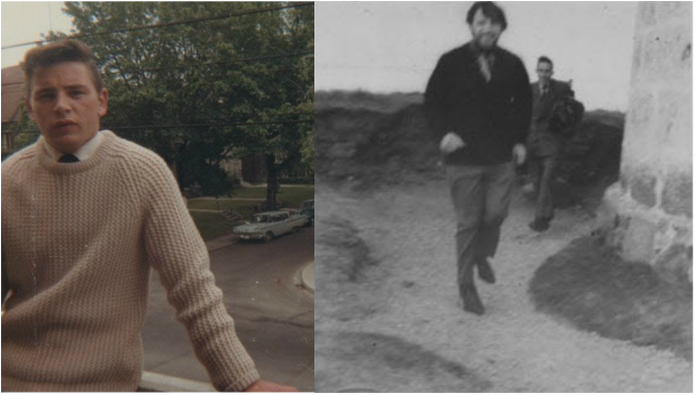
"They say that behind every picture  there's a story to be told. Like me, no doubt many of you look through old photographs of yourself, some flattering and some otherwise. These images represent a snap shot of our lives at the time they were taken and they often, I feel, provide a glimpse of what we were then thinking, our prevailing mood, our attitude to life or even the expression of yet unfilled dreams.

The picture on the left is me in Toronto, Canada in 1964. At that time, I was riding high on the crest of my dreams and anything and everything seemed possible if I reached out for it. This was a time when a girl on my arm was plentiful and I never went in short supply of my most pressing desires. The world was my oyster and I walked down the street as though I owned it!

The picture on the right is four years later in 1968.This was the age of the 
original hipster; a subculture of the middle-class lifestyle, an aspiring person who resides in a gentrified neighbourhood, goes to work in a suit and tie, sports a beard, wears sandals or winkle picker shoes, advocates progressive Liberal politics and is generally cool in all they do.

Having returned from Canada towards the end of 1965, my attitude towards life had uncomfortably moved me out of my working-class credentials and placed the mantle of middle-class aspirations around my neck. At the time, nobody went on holiday without returning with enough photographs to make a slide show that could be shared with friends after a Saturday night evening meal at either yours or their house.The couple who went on holiday relished in seeing their exploits again, while their captured slide show audience waited patiently for the holiday film show to end and have the lights switched back on.

​For those whom I have temporarily captured as an audience, I will explain the picture on the right. I was born in County Waterford, Ireland, where I lived for the first five years of my life before my parents brought their growing family to West Yorkshire. Now, while all people know where they were born, very few, I would suspect, know where they were conceived. I always had an open relationship with my late mother and being her oldest child of seven, she told me things that she would never have dreamed of telling my younger siblings. One night when we were alone in our house, I boldly asked her where I was conceived. She looked a bit taken aback by my bold request to discover the precise spot of my conception and then in smiling reflection replied, ' About six or seven yards from of the Metal Man, Billy, in Tramore, County Waterford.'

Prior to my first marriage, my fiancee and I went on holiday to the land of my birth and during it, we visited the site where it all began; the 'Metal Man' in Tramore. Tramore is a seaside satellite town of Waterford City which was once a small fishing village. Its most prominent feature is the 'Metal Man', a large cast metal figure atop a high stone pillar pointing seawards. It was erected in 1823 by Lloyds of London to warn seafarers away from dangerous shallow waters.

There are a number of Irish myths and legends surrounding the 'Metal Man'. One such myth was that if a woman could hop barefoot around the base of the 'Metal Man' three times, she would be married within the year. As my mother had clearly hopped around it on/about the time of my conception, I couldn't come back to England without hopping around it thrice myself. My grandfather followed me around, to make sure that at no time did both feet of mine touch the ground. 

The strangest of things occurred to me many years after, which I simply put down to the magic of Irish folklore. Over the years that followed, I revisited my homeland many times and I repeated the hopping exercise around it a further twice, making three times in total. Between the ages of twenty six and seventy, I was to marry three times! So, anyone out there who is unattached and yearning to be married one day, you know what to do: book your holiday to Tramore, County Waterford, Ireland, stop hoping for love and marriage to happen and instead, get hopping!" William Forde: October 28th, 2016.
Picture
0 Comments

October 27th, 2016.

27/10/2016

0 Comments

 
"Thought for today:
In wildness, we follow the growth of love, and in the sound of its silence, we discover the cry and birth of mankind. When I think back and recall the liveliest people I have ever known, they have been the wildest; the ones with a streak of adventure that would never be satisfied until the wanting of travel had waned and the bones of old age had beckoned. I believe that it is only through the finding, the harnessing and expression of one's unbridled wildness that the mind is susceptible to the openness of endless possibility and self is at last found.

When I was a teenager eager to do all there was to do and to see the world, my mother used to tell me that she could sense a wildness in me that would never be tamed. It was as though she was forewarning me of a rawness to my nature that would refuse to be trapped by convention or molded in the ways of modernity and mediocrity. She said that I possessed a burning desire to live life to the full; a feeling that would never be stemmed until the day I died. Over the years, I have given vent to both my gentleness and wildness; I have been able to access and express within my emotional make-up, my feelings of maleness and femininity, presenting a balance of what I was, blended with what I am and what I would become.

During my travels in Canada, I was blessed to be able to see wildlife on the plain and walk through tall forests with trees that were higher than the eye can see. Unfortunately, I witnessed the hewing of these magnificent specimens which have graced the earth with their splendour for a thousand years, being felled like dead bodies on a battlefield. I have always seen trees as sentries of the soul, providing us with the breath of life and the oxygen of salvation.They possess a spiritual redemption which adds to nature's revelation, and each one that is felled for profit sees a root-part of civilisation forever lost.

I recall seeing my first wolf in its natural habitat of the wild whilst I lived in Canada a few years during the early 1960's. Canada supports the second largest gray/grey wolf population in the world, after Russia. The gray wolf, also known as the 'timber wolf' is a native to the Canadian wilderness. In the wolf, I have always seen the beauty and grandeur that is wildness incarnate. On those few occasions when I was in the Canadian wild, away from the hustle and noise of everyday life, nature reminded me of my humanity and reinforced what we are connected to, rather than separated from. When we can stand still and open our ears and hearts to all life around us, be we high up in the mountains or way down in the woods and streams; it is there we find the fountain of life. We can never have enough of nature and the beauty of real freedom, which I believe is to be found in wildness and rarely in civilisation.


During the 1970's, I was the founder of 'Anger Management', a process which I freely gave to the world and which mushroomed across the English-speaking world within the space of two years. During those years of behavioural research, I learned that in all of our lives, there is an awakening of wildness, a season for settledness and a time for becoming our true selves.

Essentially, the people who were the hardest to help and who presented the greatest resistance to change were not the aggressive types, but the non-assertive person who never expressed their anger and avoided all manner of confrontation; the ones who were too fearful to ever show the wilder side of their nature. And yet, though they seemed to be devoid of anger, it was always present within; never openly expressed to others, but instead directed inwardly at oneself. Whereas the aggressive person would be prone to emotionally explode, the non-assertive person would implode and self-harm.

Subsequently, I grew to accept that it was unwise to consider wildness distant from any person, be they openly aggressive or acutely reserved. I began to see wildness as being emotionally trapped within the traumatic experiences of a person's problematic response; something not always expressed, but always close by. Through many years of behavioural research, I discovered that the emotions of expressed fear and expressed anger are inversely proportionate within the aggressive and the non-assertive person. I learned that violent people display too much aggression and not enough fear and that timid people display too much fear and not enough aggression. By placing both problem response types alongside each other in group programmes, and teaching the aggressive person to express more fear and the timid person to express more anger, both types were able to learn from each other how to respond to problematic situations more appropriately. 

My advice to all people is that when wildness calls, you should go; whenever you feel angry, you should express such feelings openly and appropriately. People with entrenched patterns of avoidance behaviour, who never face stressful situations head-on, are advised to first understand themselves before they try to bring about positive change. I have always found that the best way of discovering the true understanding of one's self is similar to that of better understanding the wild nature of the woods; it involves going through it and never travelling around its perimeter.

So the next time you see the image of a wolf, look more closely and see both natures of yourself running side by side." William Forde: October 27th, 2016.


Picture
0 Comments

October 26th, 2016.

26/10/2016

0 Comments

 
Thought for today:
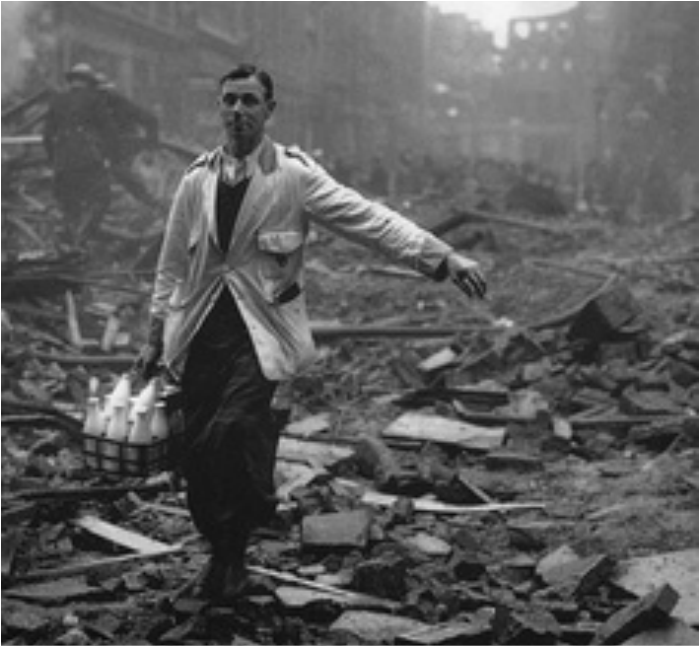
"When I came across this photograph of Great Britain in the 1940's with the milk man continuing with his daily round, in spite of the carnage from the previous night's bombing that surrounded him, it brought home to me the true grit and character of folk then as opposed to now.

Everyone who was born between both World Wars was brought up with a work ethos that has since been unmatched. I was born in 1942 and when I started work at the age of 15 years, employees who changed their jobs were often frowned upon and generally seen as not being loyal and reliable. In the main, receiving a watch or an inscribed clock from one's firm upon retirement after 40 years service was not uncommon for most households in the land.

As a child growing up on Windybank Estate, while all children played hard, we were also brought up to work hard. I can recall that by the age of 15 years, apart from walking a mile daily to fetch the family shopping from the friendly grocer, Harry Hodgeson (who allowed us to tick our food and pay for it one week after we'd eaten it), I also had a firewood round, a paper round and I worked in Mr. Northrop's grocer shop on the estate every Saturday morning. Most of my earnings went into the household finances and my only surprise was that when I got my first proper job at a mill in Cleckheaton, my father didn't make me do a milk round as well, two hours before I clocked in at the mill! All of this was a common occurrence for the young then; and now that I look back upon it, I was expected to perform these tasks after having been in thre hospital for nine months, following a serious traffic accident at the age of 11 years, and being unable to walk between 11-14 years of age.

My one puzzlement with me being a Roman Catholic, was the common use of the term, 'Having a Protestant work ethic.' 'Didn't Roman Catholics also possess this work ethic?' I would ask myself. It was only in later life, as a result of my interest in all major religions in the world that I learned of its origin. The Protestant work ethic, sometimes referred to as the Puritan work ethic, is a concept in theology, sociology, economics and history which emphasizes that hard work, discipline and frugality are a direct result of a person's subscription to the values espoused by the Protestant faith, particularly Calvanism. This is in contrast to the focus upon religious attendance, confession and receiving the sacrament in the Roman Catholic tradition. In short; in the eyes of most Protestants of the time, Roman Catholics were thought to consider going to church as often as possible as being far more important than going to work!

It was normal for the working classes to work hard to survive, and whatever they did, all possessed a pride in their work that made them do their jobs better and in a more 'positive' spirit, as displayed by whistling. Every day during my childhood years, I grew up to the sound of whistling all around me. The milk man whistled, the postman whistled, the coal man whistled; they all whistled as they went merrily about their daily work. One couldn't walk down the street without hearing someone whistling a tune. I frequently listened outside the bathroom door as someone having a bath whistled in gay abandon. Indeed, one of my father's favourite artists was the late Ronnie Ronalde, whom history will record as having been the world's greatest whistler. Ronnie could be heard on the radio most days of the week.

My father would have been very pleased to discover that in later life when I married Sheila on my 70th birthday, that Ronnie sent me a wedding present of an autographed compilation of his most famous whistling songs along with a signed copy of his latest biography. I never met Ronnie, but my good friend Graham Smith, who knew him and his wife very well, arranged this special treat as a wedding surprise. 

As a student of British History, I have often read or heard of our brave soldiers whistling in unison as they climbed out of their muddy trenches, fixed bayonets and marched towards the gunfire of the enemy, with almost no chance of moving fifty yards across 'No Man's Land' before they were mowed down by machine gun fire.

After the war and a newer form of austerity crept in before the Welfare State had been fully established, Great Britain gradually stopped whistling. By the 1960's, whistling had become a lost art. A part of my life that I'd grown up with had gone from my every day experiences. When I first started work, everyone whistled on the shop floor. I also know that it wasn't uncommon for someone to whistle when they were afraid or about some murky business in the quiet of night.

​As the years rolled on past the 60's, through the 70' and into the 80's, the only two types of whistlers one would hear of would be a farmer with their sheepdog and a building worker seeing a pretty woman pass by. Today, such behaviour, which was once gratefully accepted by almost all women as a compliment, is viewed as sexual harassment and carries a hefty punishment for the admirer/offender. As to attending a football match in my youth, whenever observers wanted to show their disapproval at the referee's decision on the pitch, they would give out a high pitched whistle of contempt, which in my view, was far better than the responses of fans today. Today's disapproval by the football fans can include, booing, name-calling in a way that questions the legitimacy of a player's birth or sexuality, f...ing and blinding, fighting with opposing fans, throwing coins at the players on the pitch or ripping up seats!

​I leave you with one of my father's favourite recordings." William Forde: October 26th, 2016.
https://youtu.be/trtxVvyzlrA
Picture

0 Comments

October 26th, 2016

26/10/2016

0 Comments

 
0 Comments

October 25th, 2016.

25/10/2016

0 Comments

 
Thought for today:
"I will never forget my visits to Falmouth, Jamaica in 2001/2002. Falmouth was the old slave capital of Jamaica during the 18th and 19th century and poverty is still rife there today. The year previously, the news that the late Nelson Mandela had praised three of my Afro-Caribbean books as being 'wonderful stories' had been picked up and mentioned on 'News 24.' The Jamaicans regarded Nelson Mandela as an idol.
​
As a consequence, the Custos (Mayor) of Trelawny and the Jamaican Minister for Youth Culture and Education invited me to write and publish a book for the 32 schools in the area of Falmouth. Over the next three years, I wrote five books which were placed on the school curriculum in Falmouth, and which helped to raise from their sales, many tens of thousands of £s, from which much needed school supplies were bought. They were 'The Kilkenny Cat Trilogy,' 'The Valley of the Two Tall Oaks' and 'Bucket Bill;' the latter two which can now be bought in my 'Afro-Indian Dreams Trilogy.'

In conjunction with the Jamaican Minister, I also set up a trans-Atlantic pen-pal project where thousands of school children in Falmouth, exchanged regular letters with children from predominantly white populated schools in Yorkshire, England. The aim of this pen pal project was to reduce the prospect of racism between black and white pupils and to increase their understanding of different cultures; the very same aim of the five books that I wrote and were published for the school curriculum of Falmouth.

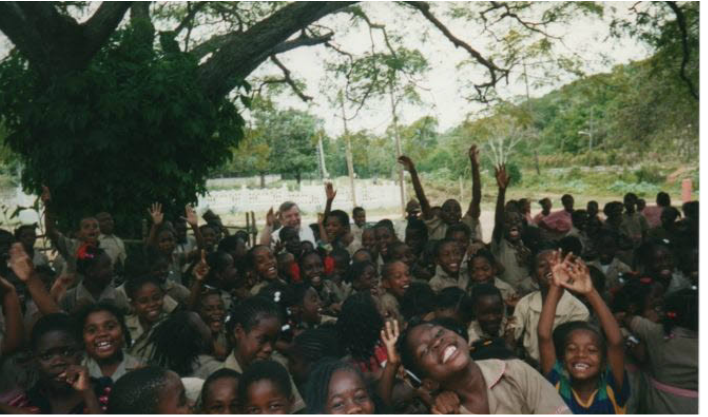
During my second visit to Jamaica, I visited all 32 schools in the Falmouth area. Some of the schools were on the edge of the beach, some were in the centre of woodland areas and a few were on the potholed roadside. All had bars on their outer doors and windows, and the floor upon which their pupils stood, was the earth itself. With regard to limited resources, pencils were cut in half, writing textbooks had to be written on both sides of the same sheet of paper and even between the lines of a previously written composition. Their libraries had fewer books than the average British home held and every family, rich or poor, had to pay educational fees to have their children schooled.

The thing I will remember most was the vast difference in behaviour between the children aged between 5-13 years and those between 13-16 years. The younger children at school wanted to learn. They were polite and attentive and dressed more smartly than any British school child I've ever seen. Once the children went to the older schools as teenagers, however, a vast change in many of them occurred.

With regard to the commission of murders, at the time, Jamaica had the distinction of being the crime capital of the world. Paradoxically, they were also the country with the most number of churches per 1000 population. There were many districts/parishes in the country which were 'no go areas' to the police and were run by drug barons who often paid protection to the police and other government employees; a situation that still exists today.

Falmouth had a higher rate of unemployment than any other parish in Jamaica, and apart from nurses, teachers, policemen and workers in banks and tourist hotels, few boys were able to find gainful employment unless they were involved with gangs and drugs. Often, the best that most nonuniversity educated girls could hope for, would be to find a man who would stand by her and their children. Hence, many of the young Jamaican women tended to become highly sexualised in their manner, dress and lifestyle. These females often viewed motherhood and partnership to a man as their only way forward. Too many Jamaican children grew up never knowing their absent father and it was the practice of many adult males to move from woman to woman as a matter of course!

And yet, the morale of the ordinary Jamaican was magnificent to behold. Despite the vast beauty of their sand, sea and mountains, they annually faced death and destruction through adverse weather forces. Over two-thirds of Jamaicans in the poorer parishes lived in accommodation that could be blown down in any large puff of wind. They had seasonal hurricanes, which at best knocked out the countries electricity supply for days on end, and at worst, destroyed humbly constructed living shacks of the poor, blocked off roads, blew bridges down and killed all those exposed to open land areas. And when the storm had passed, the Jamaicans simply got on with their lives again and rebuilt their living dwellings from whatever material they could find, beg, borrow or steal. All this they did as a matter of course; without complaint.
.
My second visit to Jamaica was something I will never forget. Almost overnight, because of Nelson Mandela's positive comments about my writing on global television, I effectively became 'famous' in Jamaican eyes and was mobbed in virtually every school I visited. That's me at the back who cannot get a look in.

​The single thing that pleases me most of all, is the knowledge that when God allocated out the land and the scenery to the different peoples of the world, He gave the most beautiful places and the warmest of hearts to the poorest of people. He also endowed them with a love of song and made many of their singers, like the late Bob Marley, international troubadours of love and freedom. Long live Jamaica!" William Forde: October 25th, 2016. 
https://youtu.be/8JFRcCpx_jA
Picture
0 Comments

October 24th, 2016.

24/10/2016

0 Comments

 
"Thought for today:
"Today is a good day to be alive. Having had a few weeks of bad pain and interrupted sleep most nights, where I have needed to get up for a few hours and make friends with the quietness of the hour, I had a full 8 hours sleep last night. I woke up refreshed and ready to fight the world once more!

There is no situation in this world that cannot be improved upon, no character trait or set of circumstances that is not open to change, no mood that need remain unaltered and no two days that dawn alike. When things of the past get you down, that is the time to pick yourself up, learn to live in the present and prepare to move forward with your life. Whenever down in the mouth, remember Jonah. He turned out okay, so why shouldn't you!" William Forde: October 24th, 2016.
Picture
0 Comments

October 23rd, 2016.

23/10/2016

0 Comments

 
Thought for today:
​"There is a wildness of beauty to be found in the unbridled passion of one's entry into adulthood. For some, it is a thing of danger where feelings are rampant and all reason is devoid of second thought. The experience can sometimes be so good that both parties know it can never be repeated; hence they have no need to exchange names and addresses. All recollection will remain an indelible memory to be kept separate from all other experiences and never bunched.

I grew up into adulthood well before my time, but it was not until I developed a liking for the older woman that I truly discovered how a person can come to lose their mind in the maelstrom of sensual madness. I recall during my early twenties being attracted to women aged thirty, and in particular, being aware of the differences in their expectations once their feelings were stirred to the edge of excitement. It wasn't so much that they were far more experienced in affairs of the heart; just that they were far better acquainted with worldly matters, full stop! I soon realised that to continue down this path of self-enlightenment was highly dangerous for a young man of unbridled passion who possessed a raw wildness that both attracted and partly frightened in equal measure, especially as there was no way of knowing if they were married unless they told you so.

And so, from thereon in, I pursued a much safer course, dating only women who were always younger than me and preferably single. I was almost forty years old before I started to settle down into the resemblance of a respectable married man who had stopped yearning for the return of his youthful years of wild abandonment. Between the ages of forty and seventy, each year has seen a gradual decline in the degree of visual, physical and psychological stimulation my body requires to keep it sensually alive, especially since I had two heart attacks thirteen years ago. 

While I still find it easy to rest my eyes on beautiful women, I no longer have the need to look twice or as long when they happen to pass by and have long since been able to detach my sight from any fleeting mental thoughts. I have been helped in this process tremendously through my increased love of art, music, pictures, imagery, and in particular, writing romantic stories, along with a few 'strictly for adult' novels. It is as though, through the process of transference, I have been able to express all of the feelings I have continued to hold through my love of writing, instead of unhealthily suppressing them. Through both the words and deeds of the characters in my published romantic stories that I now write, I am still able to feel and flirt with all the thoughts and emotions that I've always felt and still act out my feelings vicariously, whilst remaining true to self.

I now know why so many famous artists of the past were Lotharios, frequenters of dens of iniquity and visitors of women of the night. I can now see more easily why many became gurus to the young, were constantly attracted to married women of their social circles, and remained forever hopeless romantics. Paradoxically, one may need to be a sinner before sainthood beckons. Perhaps it is only after one has trod the path of lower morals, that one is better positioned to express those that are found on a higher plane?" William Forde: October 23rd, 2016.
Picture
0 Comments

October 22nd, 2016.

22/10/2016

0 Comments

 
Picture
Thought for today:
​"'I really would like to help you, but my hands are tied' is one of those responses which would have done Pontius Pilate, the fifth prefect of the Roman province of Judaea, justice. So many of us find it easier in our lives, when faced with inconvenient circumstances that we can neither stomach nor condone, to wash our hands of all responsibility and turn the other way.
We are all guilty of such action from time to time. Indeed, it could be argued to be a basic instinct of survival. Some might even say that were we not able to emotionally detach ourselves sometimes from the plight and struggle of others, we would drive ourselves into a pit of remorse and guilt because we had more than some other needier individual.

​It might also be argued, that because the action of no single human can ever bring world peace, feed the planet, house all the homeless or service the sick, that this is an excuse for any individual to do nothing. It isn't! While we may not hold any individual responsibility to provide for all, we do have the responsibility to take from none; and even if we are unable to make one person in the world better, it is simply inhuman to make the circumstances of any person worse and their struggle for survival, greater.

Trade tariffs, employing third-world labour at minimal cost, the destruction of healthy food surplus in order to maintain market prices at their highest, and the farming/manufacturing subsidies of richer economies to their own work force to the economic detriment of less well-off countries, are all modern-day means of depressing the poor of the world while enriching wealthier nations. Discrimination, racism, intolerance and nonacceptance are other means of hurting instead of helping.


In short, we often find it convenient to believe that our hands are tied and that we are helpless to intervene with any significant difference. To believe this is so wrong; it is so misguided a view to hold and is too pessimistic a purpose to follow.
​
Where does one person begin to help another, we might ask? First, I believe it is our human responsibility to acknowledge the plight of all, even if we choose not to march in protest or do anything concrete to ameliorate it. Next, there is no point of believing in the power of prayer if we do not pray for those in need. At the very least, we can give our verbal support to their situation. It helps another in dire circumstances to know that they do not stand alone, far more than we could ever imagine. I always remember the late Nelson Mandela saying in his autobiography, how much it sustained him during his 28-year's incarceration on Robben Island when he received one particular postcard of support reminding him that the world had not forgotten his ordeal. The postcard arrived during a moment when his will to carry on was at its weakest; at the most opportune moment in his lengthy sentence, when his morale was starting to wane.

Giving of ourselves not only helps others; it also helps us to give. Between 1989 and 2005, I visited over 2,000 Yorkshire schools to hold reading assemblies, During this time, I was left in no doubt as to the most important lesson taught in our schools by the teachers to their classes of children. It wasn't English, Maths, History, Geography or any other of the subjects on the educational curriculum. The single most important lesson that all school teachers taught their young pupils in every school I ever entered was the 'value of giving to those less well off than ourselves.'

Never once did one week pass by when I didn't see some class or group of school children collect money for some charitable cause, whether the school was in a wealthy area or an economically depressed one of high employment. Their concerted action of generosity reminded me forcefully, that it is only through the giving of ourselves and what we have, to others who are less fortunate than we are, that we become the good person we are meant to be.

​We should, wherever possible, give our time, our support and our money in the many countless appeals for help that daily surround us. It may be adopting the simple practice of placing a twenty-pence piece or our loose coppers in the charity box on the counter of the shop we daily frequent, giving our surplus clothes and belongings to charity shops to sell, setting up some small monthly donation for a few pounds to provide clean water to some village that has none, or even giving a few hours a week to some charity organization or help group for the disabled and disadvantaged etc. I would even include giving a listening ear to a troubled person and a genuine attempt to understand their feelings as representing a valuable gift.


There is so much that we could opt to do once we choose to unpick the psychological rope of convenience that ties our hands.The time has come to stop sitting on them; the time to untie them is now!" William Forde: October 22nd, 2016

0 Comments

October 21st, 2016.

21/10/2016

0 Comments

 
Thought for today:
"Only a few generations ago, every well-bred young girl was given lessons in poise and posture. Her first introduction to classical literature was never allowed to enter her head until she'd mastered the art of balancing it on top first as she walked the room in an upright manner. 
Today, some parents send their young daughters for dance lessons or gymnastics in the hope that they will grow up to be graceful young women rather than couch potatoes.

Have you ever wondered why there are so few women who possess a quality of poise these days? Perfect poise involves the ability to sit upright, pick something off the ground and still look good when bent, get into or out of a car or stride a windy sidewalk without showing all onlookers everything a lady's dress is supposed to conceal. Perhaps it is because we no longer highly value proper poise, elegant carriage or good posture.

It may sound far-fetched, but did you know that to be an honest person requires learning to stand upright or that straight talking will never come out of the mouth of a crooked person. There is a procedure in Relaxation and meditation practice which is known as 'centralising one's force.' In short, this means finding the centre of gravity in the soles of one's feet and standing upright in a manner that keeps one anchored to the ground. Learn to adopt this posture and not only is it physically more difficult for a bully to push you over, but you will be more able to express your view while withstanding your ground, and you will have less inclination to run away or avoid your future responsibilities in frightening and tense situations.

When a woman is natural in poise, nothing seems capable of knocking her off balance. I'm inspired by the way that poise maintains its stance, even under attack. This is best seen when the woman is insulted or when she is caught in a potentially embarrassing situation. No polite lady scratches an irritable itch in public unless she wishes to draw attention to herself and look an ass in the process. When under fire, women with class and poise focus single-mindedly on what to do and how best to do it. They forget mistakes, forget failure, forget everything that has gone before, except what they are going to do now, and how best to do it! Their breeding and innate belief endows them with a philosophy that tells them everyday is a good day; everyday is Ladies' Day!" William Forde: October 21st, 2016.

​
Picture
0 Comments

October 20th, 2016

20/10/2016

0 Comments

 
Picture
Thought for today:
"Recently, as a side effect of my fortnightly hormone jabs I get to maintain my red-cell blood count, I have incurred painful hands and feet 24/7 which frequently keep me awake three or four nights a week with interrupted sleep. During such early morning hours, I have found my mind travelling back to other sleepless nights I experienced over sixty years ago.

As a general rule, I usually sleep well on a night and wake up refreshed, but that was not always so. For almost nine months of my life as an 11-year-old boy, I found myself in a men's hospital ward. I had been run over by a wagon and had incurred life threatening injuries. Being in constant pain, I was unable to sleep a wink. I can still recall the stillness of the dark as other patients stirred in their dreams, coughed, winced in pain, snored and farted; oblivious to my very presence and all other life around them.


I always rejoiced inwardly at six am when the rattle of the medicine tray doing its early morning rounds would bring noise back into the ward as sleeping patients would be woken up for their pill and morning jab. Imagine it: one minute they'd be fast asleep and the next they'd find a nurse feeding them a tablet while her friend gave them a Ronnie Corbett up their Khyber Pass as she stuck in a needle whilst saying,  'Just a little prick. You won't feel a thing, dear!' Then, when all the ward was awake, that was the time when I wanted to go to sleep! 

The worse thing about being awake throughout the night on a ward I found, was hearing some poor soul breath his last and being aware of his body being removed and his bed being made up with fresh linen for another day and another patient. I feel so sorry for all those people who don't sleep at night, especially those folk in hospital who face the darkness alone. In many ways, I don't suppose it's much different to having to face one's future life alone, particularly when circumstances seem too dark to navigate the storm.

As I am composing this 'Thought for today' the clock has just chimed 2.00 am and suddenly an ambulance siren breaks the silence of the night as it speeds towards its emergency patient. My thoughts instinctively flit between the hospital ward of my youth and the angels of mercy on their ambulance run now. I hope deep down that they arrive in time and that there is no need for any more fresh bed linen tomorrow morning. I'm feeling tired again so it's back to bed for another few hours to give Sheila a Ronnie Corbett. I wish!" 
William Forde: October 20th, 2016.

0 Comments

October 19th, 2016.

19/10/2016

0 Comments

 
Thought for today:
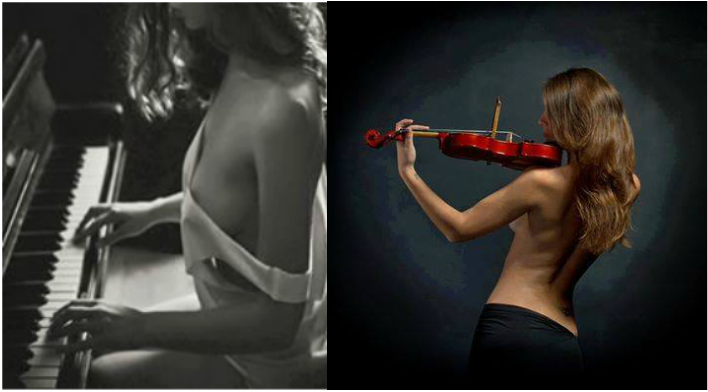
"I grew up loving all form of music and dance. My two favourite instruments have always been the piano and violin; sadly, neither of which I ever learned to play. I never took piano or violin lessons, but I know deep down that with a bit of the right encouragement and the proper teacher to instruct me, I would have jumped at the opportunity!" William Forde: October 19th, 2016.
Picture
0 Comments

October 18th, 2016.

18/10/2016

0 Comments

 
Picture
Thought for today:
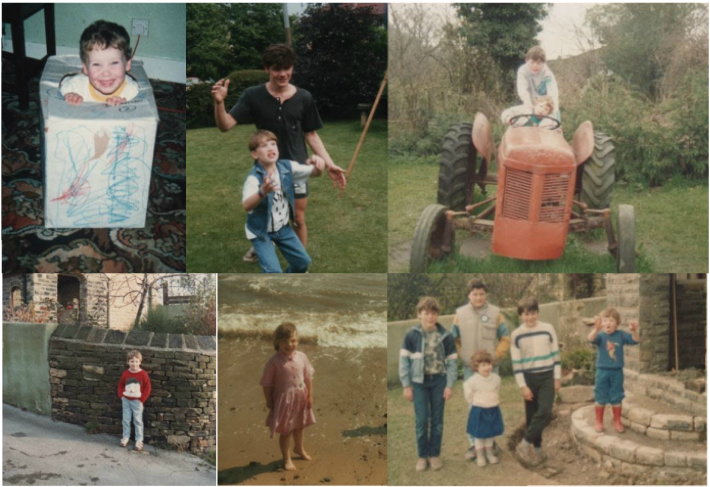
"Whatever wages parents have coming into a household today, there is a tendency to give one's growing children too much material stuff and not enough emotional stuff or imaginative things to exercise their bodies and minds.

Following my divorce, being the access dad to two children and the new father to another three (including my step son Matthew), for the next ten years, money was thin on the ground and we all made do with what we had. Our overall circumstances essentially meant greater parent involvement, playing games together, going on regular nature walks to the local woods, strolling along the canal bank, visiting the parks, spending a day on the beach, and making up all manner of stories to tell each other, creating fun from cardboard boxes and even engaging in 'the first to talk or the last to laugh competition.' And whenever I had to work at the weekend, like building a new porch to the front of the house, all the children were given their own bits of work to contribute to the improvement of our home, under our Matthew who was appointed the gang foreman.

There are so many things we did together, 'AND IT DIDN'T COST A PENNY, ONLY TIME!'  Whenever my children got a bit too big for their boots and wanted to push out the boat before they had learned the rules of sailing it, I wouldn't forbid them outright, but merely delay the process in the most acceptable way. We lived on a busy road and to keep the children safe, I erected a dry-stone wall all the way around the house boundary. When my son William was chastised for trying to climb it and run away from home, I built it another eighteen inches higher and gave him permission to attempt to scale it again, when he'd grown as high as the wall. Let me tell you, it was very hard talking the entire wall up a level each of his growing years without him noticing the build in progress!

I also recall my son Adam going through a bad patch once so I wanted to do something special for him to buck up his spirits. I asked him what he's like to do and like 9/10 boys, he replied that he'd like to drive a train or a tractor. I couldn't manage the train, but a farmer friend of mine helped out with the tractor, and all it took to make my son's wish come true was for me to ask?

James was my oldest child and in many ways the most sensible one of them all. In many ways, with him being the eldest and most responsible one, without realising it, I probably allowed him to keep the younger ones in check too much, instead of freeing him totally to be 'only a child at all times.' In so much as this, I was guilty of unknowingly repeating my own experience as a child. Having been the eldest of seven children wrongly led me to use the supervision of my oldest child with his younger siblings in a similar manner as my own mother had used me in the chain of command. I'm so sorry son if I placed too much responsibility on your young shoulders too soon in your development and inadvertently deprived you of some of your treasured childhood.

I recall our William, who was always ambitious one. Even from the age of four, he wanted to be a television presenter, so we cut out a cardboard television screen for him, placed him inside it and made him one! We made him stay in the box until he made us laugh before we'd turn him off and set him free.

My daughter, Rebecca, would never keep her shoes on and was forever running around barefoot. Consequently, she was never as happy as when we took her to the seaside.

Indeed, all of the years my children were growing up, I always told them what my mother had told me,'If you want anything from me, Billy, don't be afraid to ask. If I've got it and it doesn't harm you, you can have it, and if I haven't or it does harm, you can't!' When one thinks about it, whether one is child or adult, one cannot feel badly done to if the parent is prepared to give you anything they have!

That is why 'to give' is good and the very best thing of all that any parent can give a child is of yourself; your time, your concern, your love and your trust in their capacity to succeed. How we know if we succeed as parents, is through our children's outcome as adults. So, when we observe their lives being lived in a sensitive, fair-minded, caring, respectful, loving and honest way, with integrity written large through its centre like a stick of rock, we know they think like us and constantly of us.

Never forget that behind every child who grows to believe in themselves was a parent who first believed in them! Also know, that bringing up children is no less a lesson in life for either parent or child. We are all human and will naturally make honest mistakes along the way. I spent the whole of their childhood trying to teach them one thing or another about life and by the time they reached adulthood, they had taught me what life is all about; family and the love of it!" William Forde: October 18th, 2016.

Picture
0 Comments

October 17th, 2016

17/10/2016

0 Comments

 
Thought for today:
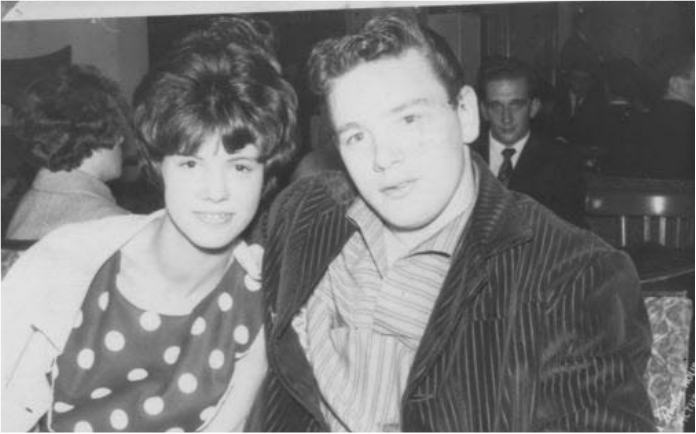
"First love is a magical thing that the memory never loses, however old one gets. I say 'First love' when deep down, it is more than likely to be a teenage mixture of infatuation and experimentation; go on then, sheer lust!

When I was 17 years old, it was 1960 and like so many others, I'd never had it so good. The world was my oyster. I worked hard in a local textile mill and I played hard on my weekends, especially during my two week's holidays from work. For the first time in my life, I earned enough money to pay my mum £10 per week board and keep and still be left with sufficient to buy myself some decent clothes and footwear. As a general rule, we'd spend all we had left all weekend and borrow off mum again until the next pay day.

The time came for me to take my first holiday outside the presence of my parents. It wasn't that I was shy with mum when it came to talking about girls and the like; more that I didn't want her butting into that area of my life now that I was old enough to do something about it. Myself and Geoffrey Griffiths had saved up some money over the previous months to put down a deposit for a week's stay at Butlins' Holiday Camp in Skegness. At that time, Butlins was the place to be if you were  looking for a boyfriend or girlfriend, without your parents buzzing around in the background. Having one's own cabin and key, provided a young man with all the privacy he could ever want.

On the third day there, I met 18 year old Rose. The only thing I can remember about her background was that she lived in the Midlands and worked as a Comptometer Operator, which at the time I'd never heard of. I thought her job to be very important at the time while it is only in recent times I learned that she operated a glorified calculaor keyboard for adding, subtraction and multiplication.

Anyway, during those four marvelous days of our holiday at Butlins that we were together, we were never apart. Geoffrey had also met a girl with whom he seemed to hit it off and the upshot was that for the second half of the week, me and Rose shared a cabin and so did Geoffrey and his girl called Eileen. Geoffrey was 18 months older than I was and he no doubt had different expectations from his holiday than I did.

Let me say now for you of curious mind, apart from sleeping together partially clothed in the most southern regions, kisses, cuddles and some grade nine heavy petting was all that me and Rose got up to. We had a lovely four days, and in some ways, it was far too good to exchange addresses or ever expect it to be repeated. Rose intended to train to be a teacher and would have her time occupied in college for the next three years and I wanted to go to either Canda or America after my 21st birthday. I had received some compensation from my accident at the age of 11 years after being run over by a wagon, and after its ten years of interest, it would be a tidy some. Even after I'd given my parents part of it, I would be left with over £2000, which amounted to two years's wages for me at the time.

I was sad when I said goodbye to Rose at the camp on our day of departure. We kissed and each knew we wouldn't see each other again. Geoffrey and Eileen though were destined to see far too much of each other during the years ahead. He wanted to keep in touch and so they exchanged addresses. Having Geoffrey's address proved very handy for Eileen, when two to three months later, Geoffrey received a letter saying that she was pregnant with his child. The thing was that the letter wasn't from Eileen, but her angry father!

In those days, abortion wasn't just considered to be an abomination; the fact was, it would never be considered by anyone! By Eileen's sixth month of pregnancy, she and Geoffrey walked down the marriage aisle. Neither set of parents could be said to have been pleased about the union, and whereas I don't know about Eileen, I know Geoffrey wasn't. However, like all the lads of his time, there was only one thing to do in such circumstances and that was to follow your parent's advice, 'The time has come for you to do the right thing after you've done the wrong thing by the poor girl. You made your bed, lad; now lie in it!'  

I'm sad to say that Geoffrey and Eileen's marriage didn't last beyond five years. On year four of it, she got herself a job at 'The Batley Variety Club' as a bunny and six months later, she moved out of the matrimonial abode, left Geoffrey holding their five year old son and moved in with the Assistant Manager of the Batley club. Twelve years later, Geoffrey died from lung cancer.

As for Rose, I don't know how her life fared, whether or not it had been kind to her and whether she ever became a teacher, married, had children, divorced or ran off with the milk man etc. etc. I wonder if she ever thinks about those four days and nights we spent together at Butlins during that summer holiday year of 1960?

https://youtu.be/1zUeAaBGVTk


Picture
0 Comments

October 16th, 2016.

16/10/2016

0 Comments

 
Thought for today:
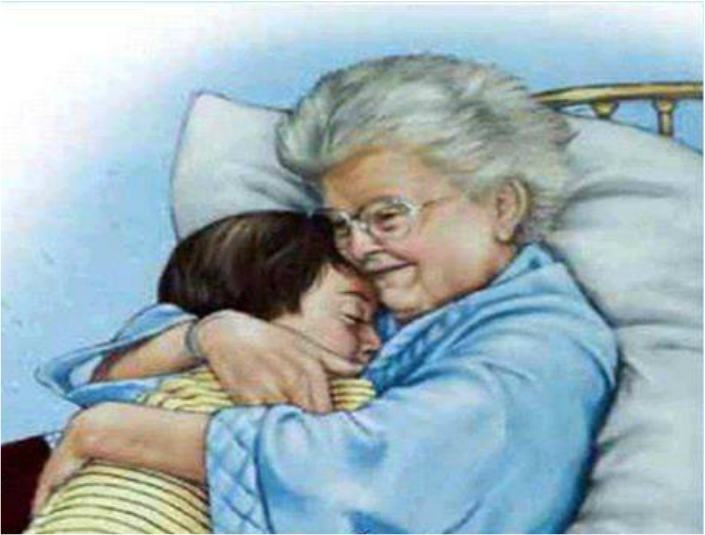
"However big your troubles, however large your heartache, however old you become, you never outgrow the comforting embrace of your grandmother's arms. You know that when she cuddles you like no other can, she gave the very same cuddles to her daughter; the mother who cuddled you in your infancy and childhood.

Many people think of a cuddle as being no more than a cuddle which anyone is capable of giving with equal effect. How wrong they are. All of your gran's cuddles have within them generations of compressed love. Each time they embrace you, they have present in their arms, the very touch of their mother, grandmother, great grandmother and as many greats as one's mind may travel.Their cuddle is in fact a part of their genetic legacy, passed down from gran to mum, to child. Cherish that cuddle and embrace it within your own behaviour as something beautiful, something to be shared and passed on to future generations.

I was born in my Irish grandmother's house, so she was as big a part of my early years life as was my mum. When I grew up, I knew that I was everything my mother wanted me to be and everything that Irish grandmother's dreams were made of. And though we came across to England to live when I was five, my memories of her remain as strong as they ever were. I can still see her face as vividly as I did at the age of five. She had a craggy, lived-in-face with a big nose. Indeed, my mother often joked that it was big enough to hang a kettle on! She always wore an apron inside the house, swore like a trooper and always baked her own bread on her large fire range. My grandfather mended bicycles for the villagers after incurring a massive heart attack at the age of 25 years. My gran insisted that he ran a cord from his working shed out back, into the kitchen. The cord was attached to a bell that she rang whenever she wanted him back inside the house. Both grandmother and grandfather smoked 40 Woodbines daily all their adult lives. Every night they would go to bed at 10.00 pm and we would hear them talking in bed until 11.00 pm before they turned off the light and went asleep. Both snored, but Gran snored as loud as a suffocating hippopotamus.

The things that gran taught me were few, but memorable. She said that we all eat two stone of dirt before we die, so I shouldn't ever bother if the bread comes out of the range a bit dirty or a slice fell on the floor as she was handing me it to eat. She made me understand that while mums knows a lot in every child's mind, their gran knows everything. I learned that whenever I went to gran for anything, she always had time to give to my concerns and make me feel special.I soon learned that grans never run out of hugs and biscuits. Whenever I hear the song 'There's no place like home' it always reminds me how true a sentiment that is; especially when home is gran's house.

I know that gran and grandad, mum and dad are all together as I write this post. God bless them all." William Forde: October 16th, 2016.
Picture
0 Comments

October 15th, 2016

15/10/2016

0 Comments

 
Thought for today:
"Did you know that flowers have meanings associated with them, and that during the late Victorian and the early 20th century, they were nothing less than floral letters. Flowers are a part of the most important occasions in our lives. They are conspicuously present on any occasion of celebration or remembrance.

I remember, Etta, a dear friend and mother substitute who lived to 94, and who treated me as the son she always wanted, but never had. During the last two weeks of her life, I remained in her home 24 hours daily. Each night and day during that last fortnight of her life. Etta's mind wandered in and out of the many years she had spent on this earth and the memories she had treasured since her late teens.

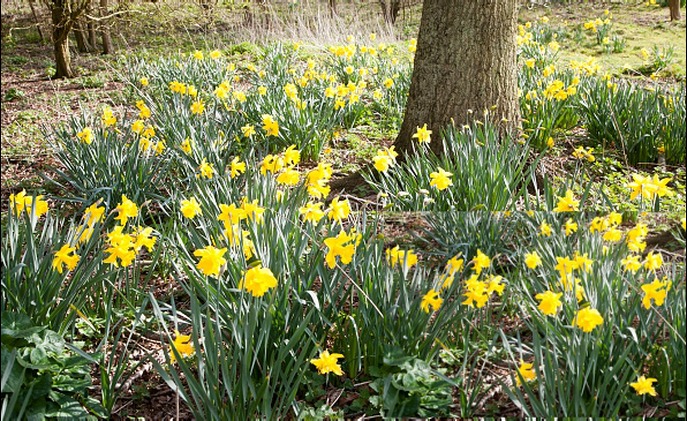
One night, three days before she died, Etta asked me to go to a Georgian book cabinet she had in her lounge and from one of the old books therein, retrieve for her an item she wished to hold once more. As requested I found the specific book she asked for and took it to her. She asked me to open the book to page 22. This was the age she was when she had first placed a daffodil inside.


The pressed daffodil had cost nothing and yet, to Etta, it was more precious than any amount of gold she could ever hold. As she was too weak to sit up at the time and was unable to even turn the pages, she asked me to look through the book until I came across pages 22 and 23, where between, I would find a pressed daffodil which she had put there during the Second World War years after her sweetheart soldier had died on the battlefields. I will never forget the fond and loving expression that crossed her face as she looked and tenderly felt the daffodil. It was as though she was caressing the bruised wings of a beautiful butterfly that had fallen to ground. This was followed by a look of remembered sadness across her face and the shedding of a few tears as she remembered, her soldier butterfly would never rise again.

Etta passed away a few days later, still holding the pressed daffodil which signified her greatest loss over sixty years earlier, and as her Power of Enduring Attorney, I ensured that she was buried with it. After Etta's funeral in the grounds of the Mirfield Methodist Chapel, where she had attended service for over 80 years, I looked up the choice of her flower which she had pressed to her heart before she inserted it within the leafs of an old Victorian book. Knowing what she had told me about her soldier sweetheart, I quickly realised the total appropriateness of her floral choice, the humble daffodil.

The reference book reminded me that the daffodil is usually one of the first floral gifts every child buys the mother they love on 'Mother's Day.' I also learned that the daffodil symbolises regard and chivalry; qualities Etta believed that her soldier sweetheart possessed in abundance. Daffodils are also indicative of rebirth, new beginnings and eternal life. A single daffodil is also thought to 
foretell a misfortune, whilst a bunch of daffodils symbolises joy and happiness.

Upon leaving to go to war, Etta's sweetheart soldier and she swore to marry upon his return. This was an event that sadly was never destined to be. Her parents had refused this marriage to take place prior to his departure and indeed, their letter correspondence took place in secret via the go-between address of her lifelong friend, Mary Milner. She was so frightened of her strict  father discovering the clandestine relationship between his only daughter and a wartime private, that she destroyed his letters as soon as she'd read them. 

After Etta's death, I'd been so moved by her tale of her soldier sweetheart and their planned marriage that wasn't meant to be, that I wrote a poem entitled, 'Arthur and Guinevere' which can be accessed through the link below.


Flowers possess a beauty that even the blind can see, the hopeful smell, the child excite and the romantic pleasurably press for future recall. Often, our finest flowers are like garden friends who are always there to support us during inclement times. It is frequently the most splendid flowers that bloom most beautiful and strongest from the experience of their darkest moments." William Forde: October 15th, 2016.


https:weebly/main.php//www.weebly.com/
Picture
0 Comments

October 14th, 2016.

14/10/2016

0 Comments

 
Thought for today:
"We get more done in satisfactory and meaningful ways when we get our priorities right. Just as each person is different to the next person in the bus queue, the differences in the priorities we set ourselves can vary enormously.

When I was first married, my best friend Christopher had one overriding priority and that was to be wealthy enough to retire at the age of 45 years. This burning ambition inside him was stoked by the death of his father by suicide after his father's textile business had failed. Christopher was highly successful in his job and was the joint owner of a mill before he was thirty. Unfortunately, his long hours at work and the preoccupation with his job, even when he came home, eventually turned out to be at the expense of his marriage. His wife started an affair with one of Christopher's employees, and after moving in with the new man in her life, she and Christopher divorced. 

Another friend of mine called Matt, who was a fellow student on the course where we trained as Probation Officers, had the opposite priority to that of Chris. Matt had been a miner and was over the moon to be accepted for Probation Officer training at the age of 45 years. The most memorable thing about Matt, which none of the other thirty course members (including myself), would do, would be to give his full time and attention to whoever sought him out when he should have been diligently studying. Sadly, poor Matt never got to complete his course. He had a heart attack driving home one Friday evening for the weekend. I attended his funeral service in Peterlee. The church was packed to the rafters and there were literally two to three hundred friends and family there. Matt was probably the most loved man I ever knew, God bless his soul.

I have known far too many people whose priorities become greatly confused when they have lost a loving partner for whom they still grieve years after. Many of them feel that they've had their ride through life and thoroughly enjoyed the journey. Some would feel guilty if they considered pushing their boat out again instead of resigning themselves to widowhood for the rest of their days; hence their priority is to preserve the memory of the deceased at all cost. While I am not advocating that widows and widowers should or shouldn't join the courting scene again, remarry or live with another, I am advocating a change in priority for those who never go out anymore to enjoy themselves following a bereavement. A ship will always be safe in harbour, but the bottom line is, 'that is not what ships are meant to do!' Ships are meant to go out into the world and to sail uncharted waters, just as all bereaved humans who lost their soul mate are designed to do! Living involves risk and living again involves greater risk.

The young today, never seem to have enough time to do the things they want to do. I frequently tell them that though the age and world they grew up in was much different to mine, the one thing common to us all is 'time.' When all the water has been drained from the cooking pot, that's essentially what the stuff of life is; time! That's what life adds up to. At the start of every day, you are credited with 86,400 seconds of valuable time. Don't waste one second of your day! Hurrying or trying to find short-cuts to life are essentially wasteful and meaningless, as most things have a tendency to happen in their own time.

The most poignant and often saddest of situations is when a couple who are able to have children, want children, but never seem to get children! Conception constantly evades them, however, no matter how many times they try too become parents. John and Joyce were friends of mine when I first married. The upshot of their failed efforts to start a family was that John always felt under pressure to perform and his wife, Joyce, always felt unfulfilled. Joyce was constantly subject to periods of depression and low self-esteem all the years I knew her. They had tried everything imaginable to spice up the experience of procreation and make it happen, but to no avail. I still recall John telling me one night at the pub, 'Ever since me and Joyce have been married, Billy, I have never never made love, as I'm constantly trying to make babies!' 

There is nothing like being confronted with the news of a terminal illness or some near death experience to get one to re-evaluate their priorities. There is simply no time more pertinent than this when we learn what really concerns us. This becomes the moment to recognise that trivia is but a small matter. This is the time to dump all pettiness and to grow a new perspective. Since I learned of my own terminal condition, I have tried to do some things differently and better than before, such as listening with the intent to hear and understand as opposed to listening with the intent of reply. I have learned that the most important things we do in life, is often done with our own families, within the walls of our own homes.

I have tried to be more conscious on occasions of my own actions and to respect the right of others to stay still when the 'do-gooder' part of me thinks they ought to move. We have all known the type of Good Samaritan whose speed to help often backfires. I refer to the person who seeks to help another without exercising sufficient forethought; the Good Samaritan who sees an elderly woman with a stick stood on the other side of a busy road during rush hour traffic. Seizing the moment, he gallantly helps the old woman across the road, only to learn when they reach the other side, that she'd already crossed the busy road before he'd come along and didn't want to cross back. She was merely catching her breath and was perfectly happy where he'd found her! 

A few priorities I would love society at large to adopt would include, laugh more and enjoy the moment. Know that things will happen in their own time if they're meant to happen at all. Accept that there are no short-cuts to life and know that you'll never produce a baby in one month, even if you get nine women pregnant simultaneously! Recognise that nobody knows 'the truth' and that all we ever know is 'a truth.' Know that the same events will invariably produce different experiences for each of us. It is easier and less exhausting to forgive than to hang on to bitterness, and is good to forgive; not necessarily because they deserve it, but because you deserve the peace that only forgiveness can bring. 


Though we may occasionally try to deceive others as to our true self, none can deceive ourselves. Put trust in God's innocent creatures and know that we are truly at our best when we are the person our dog thinks us to be." William Forde: October 14th, 2016.
Picture
0 Comments

October 13th, 2016.

13/10/2016

0 Comments

 
Thought for today:
"Most of us will never forget the first boy or girl we ever kissed, along with the circumstances in which that momentous event took place. My first kiss was with Winifred Healey. I was ten and she was going on eleven. It was next to the school peg where we hung up our coats before going into class. Seeing Winifred stood there looking lovely, I stole a kiss. At first she looked surprised, then seconds later, she smiled and stole one back! I don't know what it was then about being attracted to an older woman; perhaps it merely reflected the urge of an impatient boy to hurry along the biological learning process! The sheer power and impact of that first kiss kept both of us locked into each other's close affections for the next four years. When we left school, our paths diverged and we went our own way; I entered the mill and she entered a convent to become a nun.

Indeed, Winifred was indirectly responsible for setting me on my path of crime. After we'd exchanged kisses, I felt that I loved her so much that the very next day, while having tea at my friend's house, I stole a diamond engagement ring from Peter Lockwood's twenty-year-old sister to give to Winifred the next time I saw her. Once Winifred started showing the sparkler off to all her girlfriends, I rapidly became police suspect number one. Following that theft, Peter Lockwood's sister broke off her engagement with her fiance, and for a number of years after, I always wondered if my act of theft had brought matters to a head between the engaged couple.


Kisses have been used to communicate all manner of messages throughout the ages. No more will the male admirer kiss the gloved hand of the woman. Today, it will either be the air, cheek, lips, feet, ears, neck and all manner of body parts that will be kissed, dependent on the nature of the relationship and the purpose of the peck.  

I once recall being told by a young woman that some of the best kissers she'd ever known had been first timers or frogs as she called them. Not understanding her at the time, I naturally looked confused and asked her for an explanation. 'When a bloke kisses you' she said, ''it's as though he goes all out to show you how experienced he is with the ways of the world. He invariably gives you a marathon mouth job that leaves you gasping for breath, which he mistakes for exhilaration instead of suffocation! Some Lotharios may even try to tongue tie you as they attempt to provide you with additional tuition in exercising your glands. The best kissers I've known have been frogs. Strangely enough, they just don't jump in feet first. Often, because of their lack of practice in the kissing arena, they don't dive in at the deep end before they've learned to swim. No; give me a frog to kiss any day!' 

Whether you catch a kiss as a child as it is blown to you by a loving parent, or snatch a kiss as a boy on the cusp of youthful infatuation before the girl has had a chance to slap your face for gross impudence, or steal a kiss from a sleeping beauty as she smiles in slumber; it will remain special to you.

A kiss on the lips is the most intimate of all gestures. The reason is that a kiss never lies. From relationships between two passionate people who were so much in love at the start, yet end up, growing apart after a number of years, the kiss is always the first thing that goes; even before all sexual contact finally ceases. I recall once reading that prostitutes will engage in almost any activity for money, with the sole exception of kissing their clients; as kissing is considered too personal, too intimate, too priceless and is beyond the bounds of sale.

Never underestimate the importance of a kiss as it is probably the most significant statement we will ever make. As the famous Mae West remarked, 'A man's kiss is his signature.'

I'll end this post with one of my late mum's pieces of advice, 'Never close your eyes when you're kissing someone, Billy, because she might just be laughing at you and taking you for the fool!' William Forde: October 13th, 2016.
Picture
0 Comments

October 12th, 2016.

12/10/2016

0 Comments

 
Picture
Thought for today:
"Let's face it; anyone who turns up a chance to hang around in the arms of sweet Sheila can only be as bent as a banana or is sadly lacking in judgement. Why should anyone settle for peanuts when they can have it all?

This photograph was taken in the Market Square in Marrakesh in Morocco during our honeymoon in 2012.There was Sheila and I strolling through the Square; she looking around at all the different sights while I was eating a bag of nuts, when all of a sudden a runaway monkey appears, ignores me and the nuts and leaps into Sheila's arms! The monkey's actions simply confirmed hugs to be the universal reassurance of all animals and humans, especially if the rescuer of your heart, like Sheila was of mine, happened to be born in the Chinese Year of the Monkey.

Lay back in the arms of someone, lay back in the charms of someone; lay back in the arms of someone you love." William Forde : October 12th, 2016.

https://youtu.be/opJyRioBHp8?list=RDopJyRioBHp8

0 Comments

October 11th, 2016.

11/10/2016

0 Comments

 
​Thought for today:
"I was once told of an old wooden bridge that can be found on a beaten walker's track in a place called Kinlochbervie, the most northerly port in Scotland. Over the years, the bridge has come to be known as the 'Love Bridge.' Kinlochbervie is virtually the last place you come to before falling into the sea. It is 60 miles from the nearest supermarket and both its cinema and bank arrives to serve their customers on the back of a lorry. It was even short-listed by the Oxford English Dictionary as a definition of the word 'Remote.'

Kinlochbervie is home to a variety of people from all walks of life. Some, who are famous in their own spheres of interest, came there for its tranquil atmosphere and thousands of acres of unspoiled highland countryside, wonderful beaches, and fascinating wildlife. Even the weather is said to be far easier on the lungs than the rest of Scotland. Most of the people born there will stay there if any work presents itself and readjust to modest living, while those who leave because of the absence of work and move elsewhere, never lose touch with its beauty, the image of which, forever remains with them in their hearts and minds.

Like many a secluded part of the rustic countryside, the people born there have their own traditions and rules that distinguish them from other places on the map. One of their proud boasts is that marriage is usually for life, be it good or bad in its contract making. Before you run off with the idea of all the people of Kinlochbervie being good people of sound moral principle, allow me to pull you back with the cord of reality. Whereas it is true in most cases, that marriage is for life, in situations where the relationship doesn't work out to the satisfaction of both parties in Kinlochbervie, one usually winds up dead anyway; invariably in suspicious circumstances! One would find it hard to believe how easy it is to be walking the edge of the cliffs on a fine summer's day, when suddenly, the ground beneath one's feet makes one lose balance and stumble, and the rambler falls to their death. Naturally, when such fortuitous accidents occur, there is no evidence that the marriage partner to the deceased was present during those fatal moments, and the one bobby on the beat never seeks to establish any suspect nor disprove any alibi. You see, simply living in Kinlochbervie is in itself an alibi!

Allow me to take you back to the year 1964 and the old wooden bridge, where we began. Each year, there will be rarely one week goes by when a rose of remembrance is not fastened to the top strut of the bridge in recognition of someone's past love.The roses are of many shades and colours, from the lightest of pinks to the deepest crimson, the darkest purple and even black. The flower of remembrance fastened to the wooden rail is always a single rose, there being no other bloom to suffice that speaks so clear its message.

One year, a botanist called Charles Gotyah went to Kinlochbervie to research the flowers and plant life there for a book he intended to write. Naturally, to complete his research, Charles used to spend up to six or seven hours daily walking across moorland, up hill and down dale to locate as many plant species as possible. Most of his evenings would be spent in the local pub talking to the all the older men and women there who'd often tell him where precisely to look for this type of plant or that sort of flower and heather. Charles found the oldest residents of Kinlochbervie to be his greatest asset in completing the research for his book.

On August 10th, 1964, during one of his daily walks, Charles occasioned to cross the old wooden bridge for the first time, and in the centre of the top rail was fastened a single rose of off white and subtle pink. Even the leaves of the stalk it was attached to were beautiful in their own right. There were three leaves of dark green and one of rustic red that set off the rose offering to perfection. It was obvious to Charles that the single rose was a flower symbolising someone's lost love, a floral offering that had been suitably placed on the 'Love Bridge' in remembrance on the anniversary of their death.

Over the remaining eleven months of his stay in Kinlochbervie, Charles was to see many a single rose fastened to the rail of the wooden bridge. Most would be red in shade while some would be white, some yellow, and quite a few in peach. The old timer's in the pub would frequently ask him where his travels had taken him that day and what he'd seen. Often, when Charles told them about another single rose he'd seen fastened to the wooden bridge, some villager would know who'd placed it there, along with the name of the deceased person remembered and the known circumstances of their death.

Charles was fascinated with their depth of knowledge of anything to do with community life in and around Kinloichbervie. It was as though the movement of every person in the small village, where, when, who with and with what purpose was common knowledge between the church and the pub. Between them, Charles could always find some villager who could identify the remembered person by the colour of the rose and the date of the anniversary it was seen attached to the wooden bridge. Also, he being familiar with the language of roses, he was able to build up a pretty accurate picture of the message of love their bereaved was communicating to their dearly departed with their message of love.

Charles knew that the rose is the most popular English flower of all. It has a much richer heritage of romance than any other flower ever grown on British soil. No single bloom has ever been used to convey so many different messages, which only the heart receiving knows the full meaning of. The most common interpretation of the rose's meaning is one of deep affection and love. A single red rose communicates unchanging and everlasting love; a love of eternal devotion.

A single white rose conveys the message of innocence purity and peace. The villagers told Charles that when Dave Bradbury first married, he was pleased to have selected a pure and chaste woman with no blemish in her past. Though she was a mighty attractive wife, she could never quite bring herself to embrace 'doing it'. Hence the marriage was never consummated. Whatever her husband Dave did in his efforts to improve their relationship, nothing worked. Four years into their marriage, his wife Prudence poisoned herself on some dodgy mushrooms that she ate. Six months after her funeral, Dave Bradbury married a buxom milkmaid and they had six healthy children to their union. Each year, Dave places a white flower of remembrance on the 'Love Bridge' and wishes that she now knows peace.

Charles brushed up on his learning regarding the messages conveyed by a single rose. He learned that the shade of burgundy meant an unconscious love, and such a rose might be left by a secret love who never declared their feelings for the other person before they died. Dark crimson was a shade of mourning and would be used by those who were still grieving their loss and were unable to emotionally move on with their life. A single yellow rose signifies happiness and love.This shade was often left by a person who had emotionally moved on in their life after the death of a loved one, and who celebrated their good fortune of having been together every anniversary. One of the saddest roses Charles ever saw fastened to the bridge was a single black rose. Black roses communicate the end of a relationship; they effectively say 'It's all over.' Whenever Charles saw a black rose fastened to the bridge, he knew that would be the last time that deceased person would be remembered by the other person on their anniversary.

The only shade of rose he never saw repeated throughout the same year was the very first white and pink he saw fastened to the top rail of the wooden bridge on August 10th. This rose became special and mysterious in the mind of Charles. It represented a unique experience than any of the others. None of the locals knew to whom it belonged or the person who'd placed it on the bridge. Indeed, the only thing that Charles could speculate on was its symbolic message of 'thankfulness and deep gratitude.'

This rose nagged at Charles, particularly the story behind its fastening. What was the person who placed it on the wooden bridge thankful for? From what nature of experience did their gratitude grow? Charles simply longed to know, so much so, that he decided to extend his stay in Kinlochbervie. During the eleven months he'd been there, he'd gathered enough material for the book he intended to write. Being homesick for his beloved Surrey, he might have easily gone home as soon as was possible, but the distinct shade of the white and pink rose and its mystery donor had captured his imagination and would occupy his mind until he'd unraveled the mystery and put the matter to rest. He decided to wait there another month.

To ensure that he did not miss seeing the secret rose donor of remembrance, he planned to sleep out in the entrance to one side of the wooden bridge on the night of August 9th; prior to the morning of the precise anniversary of when he first saw the unusual white and pink single rose fastened to the bridge. He would use a sleeping bag to fend off the cold. If the rose bearer came towards the narrow bridge from his end, then they'd have to step over him asleep to get to the centre of the bridge. And if they approached from the other end, he would be woken by the sound of their approaching footsteps on the wooden beams beneath their feet.

The very next morning around 6.30 am when most of the residents of Kinlochbervie were fast asleep, Charles was roused from his sleep by the sound of footsteps walking across the wooden bridge from the other end to where he was. The pace of the walk was slow and purposeful. Their lightness in sound indicated them to be that of a woman in sensible heels.

Charles looked up as he slowly extricated his body from the sleeping bag. The wooden bridge span was arched in its centre and until the person walking the other way had reached its highest point, Charles could not see them fully, nor them he. Fortunately for Charles, when the woman visitor arrived carrying a single rose of white and pink, she was so preoccupied with its fastening that she failed to spot him in the distance observing her.

Charles looked at the woman. She was aged in her 70's and had her hair tied in pigtails. The strange thing though was that her hair was as pure white as white could be. The woman was so preoccupied that as she continued to fasten her rose of remembrance, she carried on speaking as though Charles wasn't close by. In fact, she seemed to ignore his very presence as he approached her. As he neared, Charles heard the woman say to her dearly departed, 'Thank you for all you did, Frank. Your Sarah will love you forever and be forever grateful. Bye, my love.'

Thinking that the woman may have had been somewhat deaf, Charles went to tap her gently on the shoulder, but as he gently tapped her shoulder, he felt nothing of substance. It was as though his fingertips had cut through air. Without looking in his direction or even acknowledging his presence on the bridge, before Charles could tap her on the shoulder again, she turned and walked away, back towards the side of the bridge from which she'd come. Charles watched the woman walk towards the bridge's entrance, then suddenly, she vanished before his very eyes!

​During his last night in the Tavern, Charles inquired from the oldest villagers there as to whom the rose of remembrance had been placed on the wooden bridge for and who was the woman who'd put it there. 'If anyone can tell you, it will be the old Toby there, the parish grave digger that was', one of the pub patrons told him.

Toby was 88 years old and although he'd given up digging graves in his 72nd tear of life, he still kept all the parish records on behalf of the vicar. Toby listened to Charles' tale and description of the woman visitor to the bridge with great interest.

'Can you tell me the name of the man remembered called Frank or the identity of the woman?' Charles asked Toby.

'I'm afraid I know of no Frank it could have been,' Toby replied adding, 'though it is the kind of mystery I won't be able to put down once you've got me to pick it up. Unfortunately, Sarah is not too uncommon a name 'round these parts! The one thing I do know is where to find out more tomorrow morning. If the anniversary of Frank's death was today, then the parish records may throw some light on it at the break of day tomorrow. I'll check the parish records for you before you head on back home across the border.'

The next morning, Charles met up with Toby at the Parish Church. Toby had arrived a good ten minutes before Charles and being highly curious to discover the identities, he'd already examined the records dating back twenty years. 'Are you sure you heard her say, 'Frank?' Toby asked. I've checked all the deaths on that anniversary date going back two decades and though they'd be thirteen folk who died on that particular day over the years, four men and nine women, the only name that comes within a mile of Frank is Fran. 'Could she not have said Fran?' Toby asked Charles again.

Charles replied, 'It's possible, I suppose.'

'For over seventy years, Charles,' Toby explained, 'two women named Sarah and Fran Southerby lived in the old cottage on the way out of Kinlochbervie. They never mixed with the locals and preferred their own company. In fact, in all the years I knew them, I never once had a conversation with them. They never went out without each other and no villager had ever seen them alone. All of us thought the sisters strange and some thought them very odd indeed. The best way to say it is to say it straight; if they weren't close sisters, they were closet sisters in sin; suspicious spinsters of the unnatural kind.'

'Five years ago, Sarah Southerby got stomach cancer and for the better part of a year, she lived in terrible pain with this incurable illness which had gone too far before it was discovered. Sarah pleaded with Doc Brooks to give her a deadly dose of morphine to end her life and pain, but the doctor refused outright, quoting the physician's creed of 'do the patient no harm.' Four days after the doctor had refused Sarah her wish to give her a morphine overdose, she was found dead. The post mortem revealed that Sarah had died from suffocation; probably by means of someone applying a pillow to her face and holding it down tight until she breathed her last. Fran Southerby refused to answer any police questions from start to finish and was subsequently found guilty at her trial in Edinborough High Court in 1959 of the murder of her lover, Sarah Southerby (who had seemingly changed her name by deed poll, fifty years earlier). She was hanged by the neck for the offence of murder on August 10th, 1960. The strange thing is that Sarah died on the very same day, precisely one year earlier to the day that Fran was hanged. And, now that I come to think of it, it was five years ago yesterday, August 10th when the first rose of that shade was fastened to the wooden bridge and has reappeared there every year since to the day!"

Charles looked gobsmacked and exclaimed, 'But however coincidental those dates are, what can it tell us? Surely you're not saying that the person visiting the 'Love Bridge' and placing the white and pink rose there for dead Fran Southerby was dead Sarah Southerby, are you?"
Toby simply smiled and replied, 'I'm saying nothing except what the parish records say and what the facts presented, along with the description you gave me, seem to suggest. And by the way, not that I want to sway your judgement, but during the last year of her life, Doc Brooks said that when he made home visits to see the dying Sarah, he found that her hair had turned from auburn to pure white and that Fran had started putting it up in pigtails for Sarah to remind her of her happy childhood.'


Later that day as Charles Gotyah travelled south back home to his cottage in Surrey, his mind could not come to terms with his experience on the 'Love Bridge' in Kinlochbervie nor with the explanation that the 88-year-old Toby had provided him with. It seemed fantastic; it was fantastic. Gotyah!" William Forde: October 11th, 2016.
Picture
0 Comments

October 10th, 2016.

10/10/2016

0 Comments

 
Thought for today:
"Part of my claim to fame must be that between 1989 and 2002, eight hundred and sixty famous national and international names publicly read from my children's books to school assemblies in Yorkshire. One such celebrity reader was the great Sooty himself, assisted by his handler Matthew Corbett.

Like many of you, I grew up with Sooty on the television screen and at the time he was my favourite puppet. Had anyone asked me then, 'Where's the best fish and chip shop in England?', without thinking, I would have replied,​ 'Harry Ramsdens'. Indeed, I remained unaware of the connection between Sooty and Harry Ramsden until later on in my life.

Sooty was originally devised by Harry Corbett who was the nephew of Guiseley fish and chip shop chain owner, Harry Ramsden. It was 1948 when Harry Corbett bought the puppet as a present for his son, Matthew, from a stall in Blackpool while on holiday. Sooty first appeared on the television screen in 1952 on the BBC 'Talent Night.' Harry Corbett won the heat and then, by public vote, went on to become the overall winner of the show. When Harry Corbett retired in 1976, Sooty's new handler was Mathew Corbett. Mathew Corbett handled Sooty until 1996 when he sold Sooty to the Global Rights Development Fund for £1.4million. Sooty is still being operated today by his latest owner Richard Cadell, who is seeking international stardom for our yellow bear.

I asked Mathew Corbet to be a celebrity reader of one of my children's stories in a Batley/Birstal school during November, 1990. Naturally, it was Sooty himself who did the reading as I stood on one side of him while Mathew stood at the other. All was proceeding as expected until half way through the public performance, Sooty beckoned me closer to him, but when I complied, out came the famous water pistol and squirted me smack in the face! I wiped my face and Sooty then apologised. As soon as I had naturally accepted the puppet's apology, out came the concealed water pistol again and I got another drenching. I was shot in the face no fewer than half a dozen times that morning. The only thing I never figured out was how so much water was stored in one little plastic water pistol! 

When we let life catch us by surprise, that is often when the most memorable moments happen. Sooty certainly caught me by surprise that November morning. The children loved the improvised performance that morning and laughed their heads off at my expense. It reminded me of the saying by Aristotle, 'The secret to humour is surprise.'" William Forde: October 10th, 2016.


Picture
0 Comments

October 9th, 2016.

9/10/2016

0 Comments

 
Thought for today:
"We all have mothers to thank for bringing us into the world and today celebrates the 88th birthday of my mother-in-law, Elizabeth, whom I have to thank for having given us all, Sheila. Thank you Mum; through your daughter, Sheila, your light will forever shine in the Chinese skies and our world shall remain a better place because of both your presence in it. A very happy birthday. We all love you, Mum Elizabeth xxxx

I once recall telling someone that I may have been able to get through my life without being a husband, but I do know that I always wanted to be a dad much more. Like many dads, I have had my memorable moments, my times of sadness and occasions which will stay within my lifetime's treasure chest. I have always tried to guide my children to have sound morals, to respect their elders and never to discriminate deliberately against young or old, women or men, able-bodied or disabled, rich or poor, black or white, Catholic, Protestant or any other religious persuasion. I can say today, hand on heart, that in over 40 years, I have never known one of them to fail to follow that guidance in every regard. That leads me to say, that in all the things I've ever done in my life, remaining a good father to my children will always be my greatest accomplishment.

So, while I willingly acknowledge there have been mistakes I've made along the way of their development, I have been positively influential and am partly responsible for the good individuals they all are today. Please note that I say 'partly responsible', as their mothers also played a vital role. However, it was themselves at the end of the day who did it; they who deserve the lion's share of the credit for the way they've turned out. I am proud of every one of the five, each for their own special qualities. It is not what you do for your children which determine how they end up, but what you have taught them to do for themselves that will make them happy, healthy, successful and wholesome individuals.

I have always believed that the best way we teach is not to tell or meticulously explain, but to show. I also believe that living and learning is best done by following good examples of another. Whenever good parenting is judged, it should not be determined by the child's behaviour, but by the behaviour of the parents! As a good parent, we do these things for our children through the setting of positive examples.

What about my biggest mistake as a parent, I hear you think? Were I to pick, but one, it would be the very same mistake that my father made, that I made, and which I believe that my children have probably made too; the mistake of putting dad up there on a pedestal!

I recall when I was growing up, I was so proud of my dad and how he had coped throughout his life in the face of adversity that one of my often spouted comments was, 'If I finish up half the man that my dad was, I will be a happy chap.' It was only when I'd got well into my thirties and had a wife and children of my own that I started to see some of my father's human flaws. While he was and would always remain 'a good man' in my eyes, I had to acknowledge that he was not 'a perfect man', nor was he a better man than I was. I removed dad from the pedestal I'd placed him on throughout my earlier life. The strange thing was, once I'd normalised dad, I discovered that I'd humanised him. He stopped being this aloof figure in my life; a man who could do anything he set his mind to, and instead became a man who did everything he ever undertook to the best of his ability.

When my son, William, visited me from Australia last year, there were a number of late nights we spent talking about all manner of things. One night the topic came around to fidelity within marriage. I told my son that whereas we all try to be faithful to our marriage partners, that sometimes circumstances and particular situations of temptation can even make a good person temporarily lose sight of the right thing to do, particularly when the wrong course is the easier and the more satisfying one to follow at the time. I spoke to my son about a time in my life when my marriage to his mother was at a low ebb. I told him it was during this period that I'd broken my marriage vows and had gone with another woman. I recall the look of shock on his face when I told him; not because he didn't realise such things are done sometimes by married people, but because it had been his father who had done so!

It was at that moment that I realised that, like myself in earlier life, my son William had also placed his dad on a pedestal and had grown up thinking me a better man than I actually was. I think he will view me more realistically in future. The real harm that holding an unreal image of one's father does to the child, is that it stops them becoming the man and woman they have the potential to be. It sets up expectations of perfection which none of us can ever hope to live up to and it prevents us from knowing that hard-to-accept truth of life 'that sometimes, good people do bad things, but it doesn't stop them being good people!' That is why it is always better to condemn the behaviour and not the person when they wrong.

My advice to my children is, 'Make your parents proud, your enemies jealous and yourselves happy. That way, you are sure, my children, to go farther than your old dad ever did, or his father, or his!'" William Forde: October 9th, 2016.
Picture
0 Comments

October 8th, 2016.

8/10/2016

0 Comments

 
Thought for today:
"Ever since the days of the Luddites who tried to hold back the advancement of machines over that of man's labour, the working classes have never allowed themselves to be trodden on. As a nation, Great Britain will always remain great, largely because we refused to be ruled or governed by those who live offshore.The Vikings couldn't do it, the Romans couldn't do it, and now the European Union have discovered that they can't do it either!

There is a determination, a downright doggedness dug deep in the heart of an English man that comes to the fore whenever respect towards him is found wanting; particularly when he displays outright defiance against all odds in his Churchillian challenge: 'If that's all you have to throw at me mate, do your worse then!' We witnessed this bulldog spirit during the Second World War, when we took on the might of Hitler's Germany, despite being greatly outnumbered in manpower, weaponry and fighting planes, whilst other friendly countries decided not to join the fight until the enemy entered their back yards and bloodied their nose. We saw this very same 'get up and go' spirit during the height of the German nightly bombings, during the Blitz and every morning after. We witnessed the dogged bravery of our pilots fighting and winning the war of the airways as they engaged in dogfights in the London skies with the superior German planes.

Brave English men in the emergency services of ambulance and fire brigade risked their lives daily as they battled on like angels of the night, retrieving injured and dead bodies from beneath the collapsed houses and ruined buildings which had been flattened to the ground, whilst all around them, bombs continued to drop from the sky, gas mains exploded and fires broke out. Imagine the sheer guts and courage it took to take a crying baby from the arms of its dead mother and after leaving it safe, display sufficient determination to return to the carnage and repeat the process. Then, in the morning after a night of heavy bombing, when householders awoke and saw their own house being the only dwelling in their street still standing, what did these brave women do. They cleaned and whitened their front doorstep, sent their children off to school and prepared for another day of defying the enemy.

Even, part way through the war when the British forces were trapped on the beaches of Dunkirk on the French coast and faced being wiped out by the mighty German Army, every small boat holder and owner of any vessel which was capable of floating, risked their lives by sailing to Dunkirk and brought our soldier boys back home, so they could fight another day. Even the 'dogfights' in the sky over London, saw badly outnumbered British pilots flying inferior planes to their enemy, win the battle of the air with their skill, bravery, guts and sheer doggedness. Never was so much owed to so few by so many!

I remember a Probation colleague of mine in Huddersfield called David Toothill. David always told it as he saw it. He expressed precisely what he felt in his bluntest of Yorkshire ways, which invariably included a few choice swear words. He pointed out to me that often, as can be found in many settings from prisons through to hospitals, schools, probation offices and even the Houses of Parliament, those on the bottom rung of the power ladder will always be able to frustrate and beat those at the top. As to why this was so, David told me during a time when the main grade Probation Officers in Huddersfield were at loggerheads with their seniors. Without repeating the numerous expletives he used within his explanation, my paraphrased version of his words are as follows:
'In any fight between the classes, the working class will always emerge as top dog, Bill, because the middle-class bosses aren't like us. Whereas they were brought up to play by the rules, the working classes were brought up to survive, and if that means kicking them in the goolies when they're on the ground and then burying them, so be it!' 

I've never forgotten David's view about getting one over on one's betters, although I very much doubt he ever did see anyone who he would acknowledge as being better than him. A bit like the British I think, don't you?" William Forde: October 8th, 2016.
Picture
0 Comments
<<Previous

    Archives

    July 2021
    June 2021
    May 2021
    April 2021
    March 2021
    February 2021
    January 2021
    December 2020
    November 2020
    October 2020
    September 2020
    August 2020
    July 2020
    June 2020
    May 2020
    April 2020
    March 2020
    February 2020
    January 2020
    December 2019
    November 2019
    October 2019
    September 2019
    August 2019
    July 2019
    June 2019
    May 2019
    April 2019
    March 2019
    February 2019
    January 2019
    December 2018
    November 2018
    October 2018
    September 2018
    August 2018
    May 2018
    April 2018
    March 2018
    February 2018
    January 2018
    December 2017
    November 2017
    October 2017
    September 2017
    August 2017
    July 2017
    June 2017
    May 2017
    April 2017
    March 2017
    February 2017
    January 2017
    December 2016
    November 2016
    October 2016
    September 2016
    August 2016
    July 2016
    June 2016
    May 2016
    April 2016
    March 2016
    February 2016
    January 2016
    December 2015
    November 2015
    October 2015
    September 2015
    August 2015
    July 2015
    June 2015
    May 2015
    April 2015
    March 2015
    February 2015
    January 2015
    December 2014
    November 2014
    October 2014
    September 2014
    August 2014
    July 2014
    June 2014
    May 2014
    April 2014
    March 2014
    February 2014
    January 2014
    December 2013
    November 2013
    October 2013
    September 2013
    August 2013
    July 2013
    June 2013
    May 2013
    April 2013
    March 2013
    February 2013
    January 2013
    December 2012
    November 2012
    October 2012
    September 2012
    August 2012
    July 2012
    June 2012
    May 2012
    April 2012
    March 2012
    February 2012
    January 2012

Powered by Create your own unique website with customizable templates.